6 March 2024
Raise your voice, Speak well, What did you say?
If these phrases are familiar to you, it means that it will have happened to you at least once that someone didn't hear or understand you. Maybe you have also asked yourself "But why did I speak so well". And it's all normal: between thinking andarticulate (good) I'm in the middle of ittraining and theexercise constants.
Bring out the sounds as they should be pronounced, e.g do it naturally, it is a process that requires study and mastery of the voice, of the sounds we emit. In a word: diction, in English diction.
What is it exactly? And above all, why is it so important for acting? How can it be improved?
What does diction mean?
Diction is the way in which sounds are, or rather should be, articulated. It doesn't mean just the pronunciation of words, but i mechanisms that are behind the sounds at the articulatory level of our language for how they should be issued.
The sounds of Italian, in fact, are not limited to the letters of the alphabet, because identical consonants and vowels have different sounds based on the words and letters that precede them, or based on how they are articulated. There s of home is not the same as that contained in the word pink. PAndsca with the And open indicates the name of the fruit, while with the And Fishing is closed.
These are some of the most common examples that help us understand how the difference in opening of a vowel, which is not marked graphically when we write, serves to distinguish homograph words in cases where the context is not enough to disambiguate them. Same thing for bortte (container), bortte (beatings), WhoAndif (verb) e WhoAndif (plural of church).
Diction is directly linked to articulation, the correct pronunciation of words and the sound of the voice. A person with good diction speaks clearly, enunciates well and "doesn't eat his words"!
An important aspect of articulation, in fact, are the ends of words. Without realizing it, we brutally cut the endings, forcing those who listen to us to deduce the word we are pronouncing.
And what our ear hears does not always correspond to what comes to those who listen to us.
The role of diction in acting
For those who act, the voice is a sign of recognition and security. The license with which you can move between the various registers and roles while maintaining your uniqueness.
In “The art of vocal acting”, James Alburger explains how diction becomes even more important when (re)creating a character. Aspects of a character's voice may include a specific accent, tempo, rhythm, attitude, or other characteristics of a specific conversational style.
With the right diction actors and actresses learn to be vocally versatile, which means being able fill different roles. Furthermore, diction is the element with which stand out during auditions showing off their acting skills.
It is with the voice that the emotions and intentions of the character are conveyed, which makes an interpretation credible.
Not just sounds
Even the pauses they come and strong. They are part of diction because they are much more than a simple interval of silence between one word and another. I am one powerful tool that serves to underline details. A pause can be any length, from a fraction of a second to a few seconds, depending on the context of the script. It is through pauses that we build tension and suspense in the minds of those who listen to us.
How to improve diction
In addition to studying and training, working on your diction requires concentration And awareness. Concentration must always be had, awareness is acquired gradually, also through listening to oneself, and that is what allows you to correct your shot, articulate sounds more precisely, give the right tone to sentences and jokes. Stand out as actors and actresses!
What can you do to practice and improve your diction? Definitely never stop practicing, train facial muscles and then focus on breathing to govern it, commit to having greater fluency, study And take care of your voice. Always!
Breathing exercises
There are several breathing exercises. One of them is
- lie down on the ground and place your hands on your stomach
- breathe until you feel your diaphragm fill with air
- then slowly blow out, controlling your breathing
This will help you lengthen your breathing and help you speak louder. It is the control of breathing that will help you sustain long monologues or long notes.
Tongue twister
Tongue twisters can help improve pronunciation and fluency. They help to master the opening and closing of vowels, to improve tone and accent.
A classic:
Apelles son of Apollo made a ball of chicken skin, all the fish came to the surface to see the ball of chicken skin made by Apelles son of Apollo.
The challenge is to read it naturally following the rules of diction for the opening and closing of the sentence And and of or.
Study of phonetics and the international phonetic alphabet
Phonetics are useful to understand the position of the tongue and the way in which the air must come out when pronouncing a specific consonant, where the articulation occurs and whether or not there is vibration of the vocal cords. To give an example:
The letter b it is a bilabial consonant because the sound is articulated by closing or bringing the lips together, and it is voiced because the sound is produced with the vibration of the vocal cords.
The IPA (International Phonetic Alphabet), on the other hand, is the international phonetic alphabet, the transcription of the sounds as they should be pronounced. To study and always keep within reach!
Repetition of vowels and consonants
To fix the way and place in which they are articulated in our phonatory apparatus.
Voice care
Don't push your voice to the limit and take care of it.
Diction is important in all performance and in general improves the voice making it clearer and removing imperfections. Inevitably it affects the way we communicate.
As actors, actresses and voice actors, acting in diction means having mastery of one's voice and above all being able to convey emotions. Whether on a stage, behind a camera or in voiceover, diction is the means of giving uniqueness to the words that pass through our voice and making them one performance memorable or not.
The diction at the SRC
As the Calabria Acting School we give a lot of space to diction with a training offer that involves not only aspiring actors and actresses. We propose single courses, individual and group for everyone, let's integrate the diction in each LAB, from mini to medium, and during the Triennio Accademico diction is among the fundamental subjects.
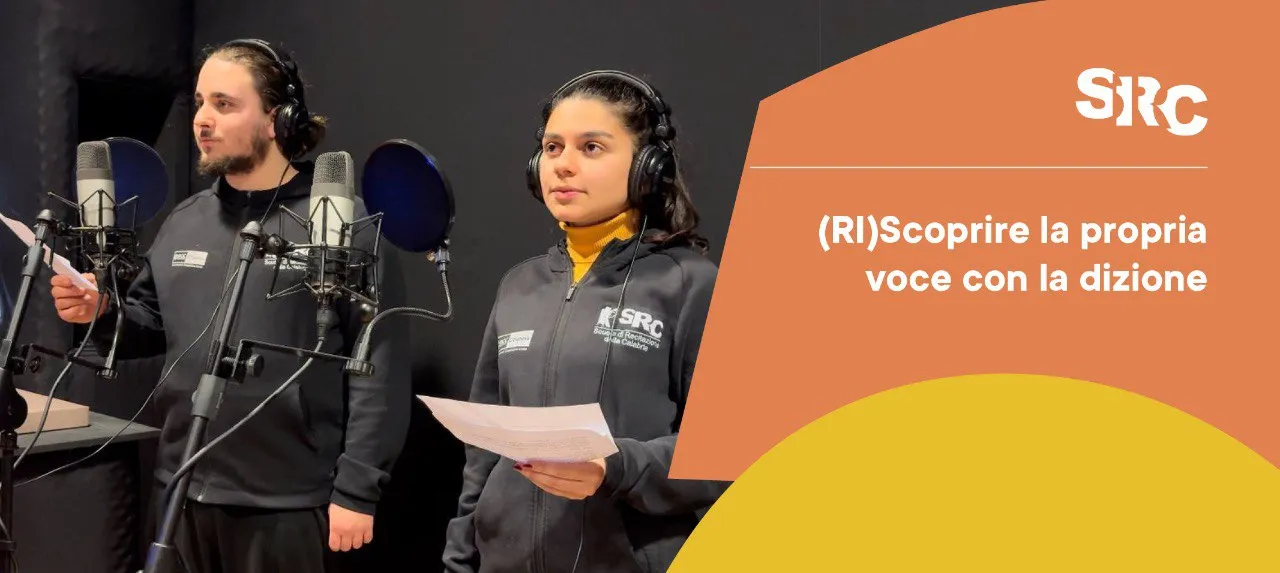
This is because diction is the discipline with which you can (re)discover your own voice, at any age.
Do you want to (re)discover yours? Study with our teachers, contact us!