24 November 2023
For us at the SRC it is an honor that he is the educational coordinator, because we respect him highly. He played Sor Ottorino Santucci, a character who, to anyone who has been to the cinema recently, will sound familiar.
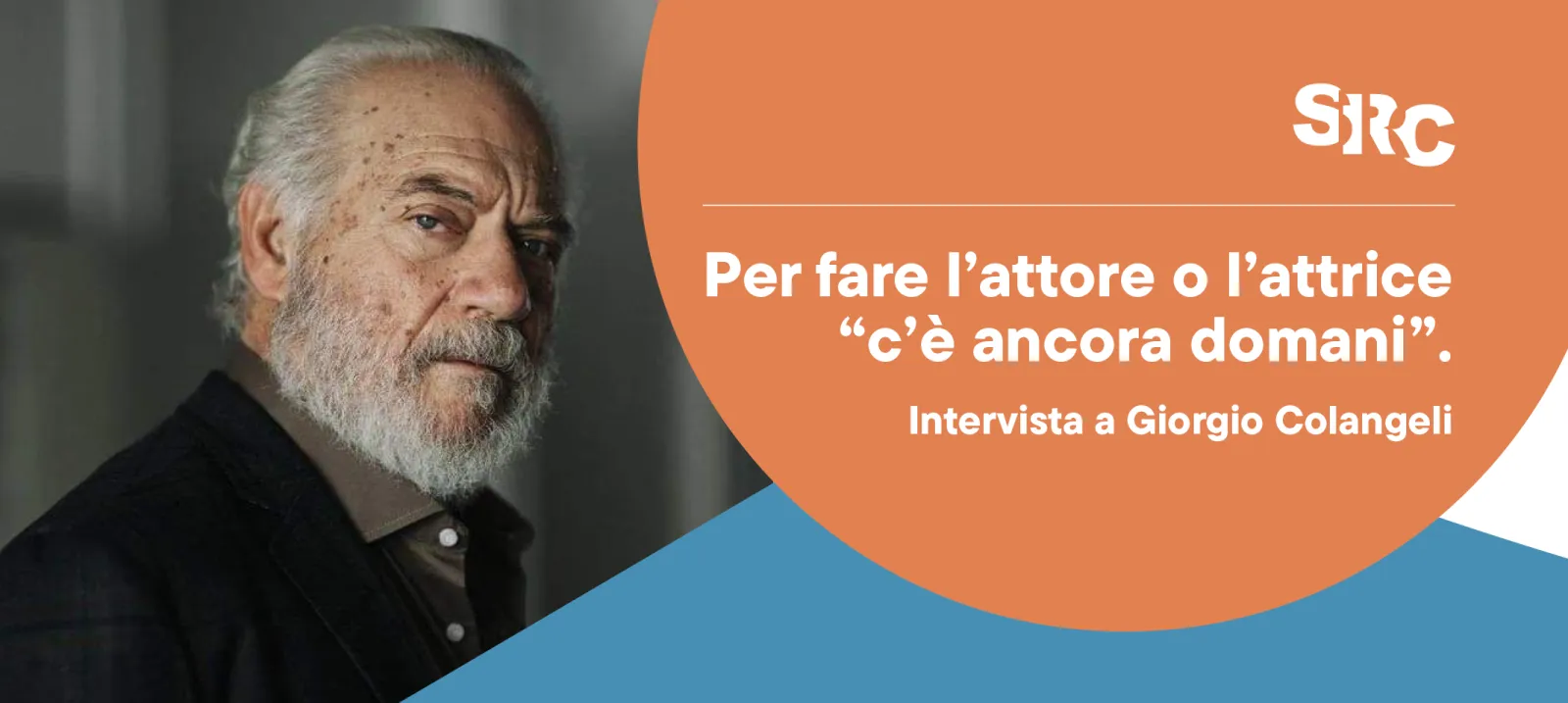
Sor Ottorino is Delia's father-in-law in Paola Cortellesi's film in her directorial debut, "There's Still Tomorrow" he is Giorgio Colangeli our educational coordinator. We asked him, who began this profession almost by chance and who achieved success with patience, in the theater and in the cinema, to tell us about his journey up to today, up to Sor Ottorino, a character on which we couldn't miss the chance to focus on the very man who played him. Often, to be an actor you don't have to be born into it, you don't have to immediately want to get into the limelight, but believe in it and never stop studying and acting. Just like he did, with passion and patience.
Who is Giorgio Colangeli?
I am an actor who came from very far away. I wasn't an actor straight away, in fact I became one almost by chance. It was 1974, I had just graduated in physics, while waiting to complete my military service a friend of mine involved me in an amateur show. Looking for a place to do this show, I know the Teatro Didattico Il Torchio company that used to do shows with children.
The sector in those years was lively. For me it was a very important period that I actually remember and carry with me in my career, because acting for children means being careful about what you say, what you give and receive. They're either interested or they're not and you can tell right away.
I continued with the Compagnia del Torchio until 1982 and in the meantime I also taught physics. In the '82-'83 season I moved to theater tout court and took part in various shows directed by Antonio Calenda.
In 1989 I participated in Aria del Continente directed by Antonio Calenda. Among the actors there were the wonderful Pietro De Vico and Anna Campoli, but the poster announced "L'aria del Continente" with Nino Frassica. The absolute protagonist is a debutant who, however, TV had made popular with programs such as "Quelli della notte" and "Riditro tutto". It was there that I said to myself: if I stay only doing theater I will never become famous. I found an agent for the cinema, but until 2003 I continued to only do theatre. In that year I gave up going on tour to make myself available for possible writings in the cinema, also because my agent had told me "Giorgio, if you continue to leave, I don't know how to get you into the cinema". I entered the cinema and in 2006 with "L'aria salata" by Alessandro Angelini I won the Marc'Aurelio at the first edition of the Rome Film Festival and in 2007 the David di Donatello, again for the same film.
These two awards opened my career in cinema and television. I returned to the theater with experimental shows and also with classical texts and great productions.
Paola Cortellesi's directorial debut has just been released. There's Still Tomorrow. How did your character experience it?
I got along very well with Paola, who I respect as an actress, as a person and as a director. A generous actress-director when directing her colleagues. As for Ottorino, I often play negative roles, but I embrace them without judging them because only in this way can playing them be a liberation, a therapeutic simulation.
This film I confess made me think of my parents, of the families of the past. Valerio Mastandrea and Paola Cortellesi lock themselves in the room and we don't know what happens. It's a scene that I've seen many times in my house, always hoping that it was my mother who gave it to my father, because my mother beat us, indeed she beat us.
A fundamental theme of the film is the condition of women in society and in couples, then, obviously, and also today. What has changed? On the surface a lot, but deep down very little. “You are mine!” Is it love or possession? Even today it is difficult to distinguish.
Why do you support the Calabria Acting School?
First of all for its founder and Director, Walter Cordopatri. I immediately respected him, as a person and as an actor and then for his noble choice to take root in his country of origin and give young people an opportunity. So many people have to go outside, leave Calabria to learn how to do this job. With the School he has the possibility to stay.
And for those coming from outside the School gives the opportunity to discover and experience a different Calabria.
What advice would you give to someone who wants to be an actor?
What would you say to pack for a young person who wants to pursue this career?
I would pack two things in my suitcase: the awareness that an acting school is still a school. A school of life, which makes you a critical spectator and aware citizen even if you are not an actor. If you become an actor I would pack the habit of training. Especially today, where it is easy to find boys and girls who improvise behind the camera of a telephone and create characters that work and think that this is enough to say they are an actor or actress. Being an actor is a job that must be learned, you set the bar and it is you who raises it because there is a little voice that tells you "you can improve, do something more!"